11
0
Support the library.
Your support helps keep books free for everyone ❤️
📍 Noticed
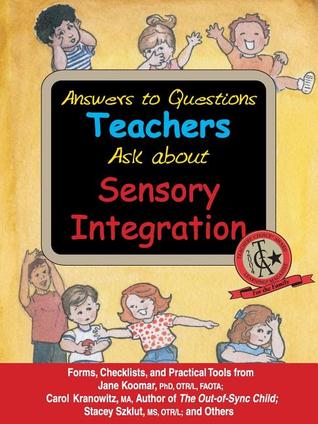
Answers to Questions Teachers Ask about Sensory Integration: Forms, Checklists, and Practical Tools for Teachers and Parents
by Jane Koomar
Sponsored
Synopsis
In this elegant approach to the often-elusive subject of sensory integration, Carol Kranowitz, M.A. (author of the best-selling book The Out-of-Sync Child) and expert occupational therapists Stacey Szklut, MS, OTR/L, Lynn Balzer-Martin, PhD, OTR, Jane Koomar, PhD, OTR/L, FAOTA, Elizabeth Haber, MS, ...
In this elegant approach to the often-elusive subject of sensory integration, Carol Kranowitz, M.A. (author of the best-selling book The Out-of-Sync Child) and expert occupational therapists Stacey Szklut, MS, OTR/L, Lynn Balzer-Martin, PhD, OTR, Jane Koomar, PhD, OTR/L, FAOTA, Elizabeth Haber, MS, OTR/L, and Deanna Iris Sava, MS, OTR/L, have assembled an extensive and easy-to-use set of checklists and other tools that will be invaluable to every teacher (and parent) who has children with sensory processing challenges.You’ll find tried-and-true instructions for developing fine-motor, “organizing,” and motor-planning skills, and for providing an appropriate “Sensory Diet” that will benefit all your students. Checklists help you identify students who have difficulty processing sensory information. With up to 20% of the students in any given classroom affected by Sensory Processing Disorder, Answers to Questions is an invaluable resource for teachers of preschool through high school.
Winner of Learning magazine's Teachers' Choice Award, this book and the tools within it will help teachers learn how to:
Recognize Sensory Processing Disorder
Understand how Sensory Processing Disorder may interfere with a child’s motor coordination, muscle tone, fine motor skills, visual perception, and relationships with others
Discern a child’s unique pattern of out-of-sync behavior
Help a child recover after a meltdown
Develop strategies to prevent future meltdowns
Approach a child who is simultaneously oversensitive to one kind of stimulation and undersensitive to another kind
Help children identify their own needs for the right amount of sensory stimulation
Collaborate with parents, occupational therapists, and other professionals on a child’s behalf
Provide a safe, appropriate, “sensory diet” in the classroom that will benefit all students
Structure a calm and organized classroom
Manage his or her own behavior when a child “pushes those buttons”
Finally, this book will help teachers to always remember that these are good children who are trying their best in a confusing world!
Contents include:
What Is Sensory Integration? What Is Occupational Therapy? How to Get the Most Out of Answers to Questions Teachers Ask
Comparison of Typical Sensory Processing & Sensory Processing Disorder Organizing Sensory Input and Activities for the Classroom Classroom Accommodation Checklist Infants and Toddlers Checklist (Birth to Age Two) Preschool Checklist (Age Three to Four) School-Age Checklist (Age Five to Twelve) Adult/Adolescent Checklist (Age Twelve and Up) Balzer-Martin Preschool Screening—Teachers Checklist Characteristics of Tactile Dysfunction Characteristics of Vestibular Dysfunction Characteristics of Proprioceptive Dysfunction Characteristics of Visual Dysfunction Characteristics of Auditory Dysfunction Heavy Work Activities List for Teachers And more!
You May Also Like

Capitalism and Its Critics: A History: From the Industrial Revolution to AI
John Cassidy

Seobe
Miloš Crnjanski

The Fabulous Clipjoint
Fredric Brown

Last Chance Saloon: A Hilarious Romantic Comedy About Best Friends and Heartbreak in Their Thirties
Marian Keyes

Perfect on Paper
Sophie Gonzales

The Silver Pencil
Alice Dalgliesh
Self Help Picks
View All
Courage Is Calling: Fortune Favors the Brave
Ryan Holiday
The Subtle Art of Not Giving a F*ck: A Counterintuitive Approach to Living a Good Life
Mark Manson

The Boy, The Mole, The Fox and The Horse - The Animated Story
Charlie Mackesy

Atlas of the Heart: Mapping Meaningful Connection and the Language of Human Experience
Brené Brown
Toxic Empathy: How Progressives Exploit Christian Compassion
Allie Beth Stuckey

The Sirens' Call: How Attention Became the World's Most Endangered Resource
Christopher L. Hayes
