1
0
Support the library.
Your support helps keep books free for everyone ❤️
📍 Noticed
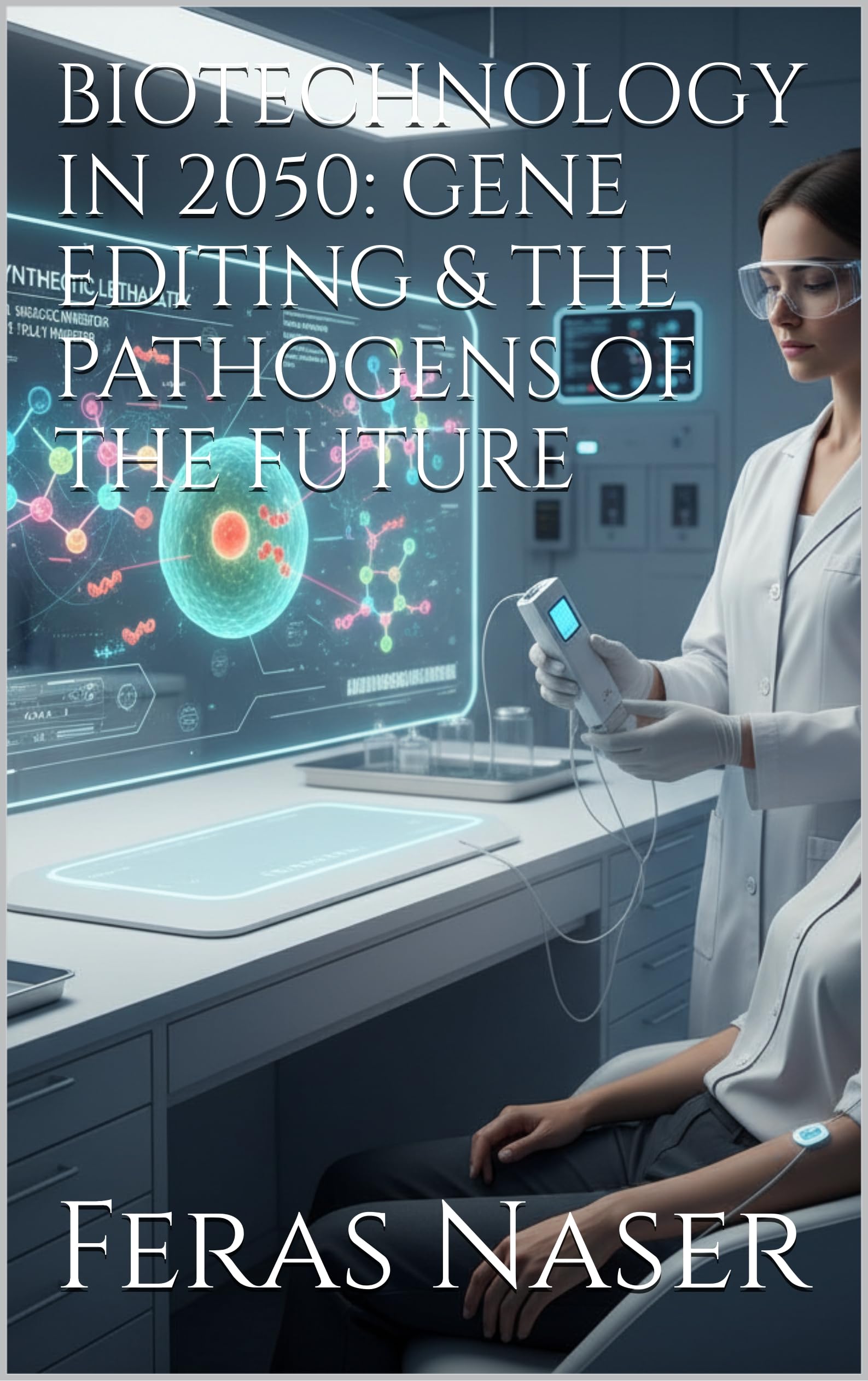
BIOTECHNOLOGY IN 2050: GENE EDITING & THE PATHOGENS OF THE FUTURE
by Feras Naser
Sponsored
Synopsis
We stand at a hinge moment in history. For millennia, humanity battled natural biological threats. Today, the dynamic has been irrevocably altered. Biology has ceased to be a science of discovery and has become an engineering discipline—one where the code of life can be efficiently manufactured, ...
We stand at a hinge moment in history. For millennia, humanity battled natural biological threats. Today, the dynamic has been irrevocably altered. Biology has ceased to be a science of discovery and has become an engineering discipline—one where the code of life can be efficiently manufactured, precisely modified, and rapidly optimized.
This is the central crisis of our era: we possess 22nd-century biotechnological power, but we cling to 20th-century geopolitical controls. The result is an Existential Risk Gap.
BIOTECHNOLOGY IN 2050 argues that the combined revolutions in high-speed Genomics, precision Gene Editing (CRISPR), and accelerating Artificial Intelligence have generated self-made biological risks that fundamentally exceed our capacity to contain them.
This book is a vital, urgent exploration into the future of global security, revealing how technological breakthroughs—intended for healing—have simultaneously armed non-state actors, rogue scientists, and even hobbyists with the ability to engineer catastrophic threats.
Inside, you will confront the three accelerants of the biological revolution:
The Unmaking of Biological Distance: The cost to sequence a whole human genome has plummeted from $2.7 billion to less than $200. Biological knowledge, once a centralized state-level asset, has been radically democratized in less than two decades. Security can no longer rely on protecting hardware but must pivot to controlling digital biological data.
The Dual-Use Imperative: The Healer's Blade: Gene editing tools like CRISPR are offering revolutionary cures for diseases like Sickle Cell Disease. Yet, the very same instruments used to correct a single DNA letter can be repurposed to systematically optimize pathogens for enhanced virulence, transmissibility, or resistance, leading to the creation of 'Designer Diseases' and 'Stealth' pathogens.
The AI Catalyst: Automation of Biological Warfare: Artificial Intelligence is transitioning biology from a slow, expensive lab process into a rapid, in silico design discipline. Projecting to 2050, the concept of the "Drag-and-Drop Pandemic" becomes tangible. AI's ability to design novel virulence strategies in a single week—coupled with automated lab robotics—compresses the time between malicious digital intent and catastrophic physical effect to a timescale unmanageable by current human countermeasures.
The book culminates in a chilling projection: the convergence of cyber warfare and biological warfare, where a novel bioweapon agent is designed not in a physical lab, but from a remote, anonymous terminal, making deterrence and attribution nearly impossible.
This is a mandate for urgent action. The question is no longer if human ingenuity can generate the next plague, but whether our collective political will can govern its creation before it controls our destiny.
Dive into BIOTECHNOLOGY IN 2050 to understand the fundamental challenges to human civilization and the radical governance reforms required to avert a self-inflicted global reckoning.
You May Also Like

Toward a Radical Middle: Fourteen Pieces of Reporting and Criticism
Renata Adler

Ready Player Two: A Novel (Ready Player One Book 2)
Ernest Cline
Star Wars: The Mask of Fear (Reign of the Empire) (Star Wars: Reign of the Empire Book 1)
Alexander Freed

Spy Camp (Spy School #2)
Stuart Gibbs

Knife: Meditations After an Attempted Murder
Salman Rushdie

Canines of San Francisco
Mark Rogers
Lgbt Picks
View All
She Drives Me Crazy
Kelly Quindlen

How to Become the Dark Lord and Die Trying
Django Wexler

Delilah Green Doesn't Care
Ashley Herring Blake

A Danger to the Minds of Young Girls: Margaret C. Anderson Book Bans and the Fight to Modernize Literature
Adam Morgan

Divine Ruin
Margot Douaihy

Kill the Beast
Serra Swift
