1
0
Support the library.
Your support helps keep books free for everyone ❤️
📍 Noticed
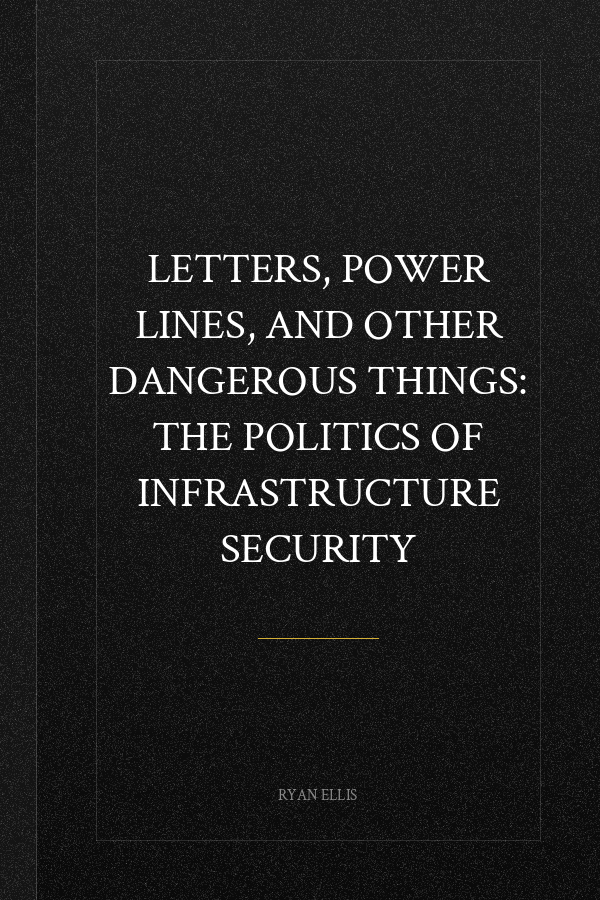
Letters, Power Lines, and Other Dangerous Things: The Politics of Infrastructure Security
by Ryan Ellis
Sponsored
Synopsis
An examination of how post-9/11 security concerns have transformed the public view and governance of infrastructure. After September 11, 2001, infrastructures--the mundane systems that undergird much of modern life--were suddenly considered "soft targets" that required immediate security ...
An examination of how post-9/11 security concerns have transformed the public view and governance of infrastructure. After September 11, 2001, infrastructures--the mundane systems that undergird much of modern life--were suddenly considered "soft targets" that required immediate security enhancements. Infrastructure protection quickly became the multibillion dollar core of a new and expansive homeland security mission. In this book, Ryan Ellis examines how the long shadow of post-9/11 security concerns have remade and reordered infrastructure, arguing that it has been a stunning transformation. Ellis describes the way workers, civic groups, city councils, bureaucrats, and others used the threat of terrorism as a political resource, taking the opportunity not only to address security vulnerabilities but also to reassert a degree of public control over infrastructure.
Nearly two decades after September 11, the threat of terrorism remains etched into the inner workings of infrastructures through new laws, regulations, technologies, and practices. Ellis maps these changes through an examination of three U.S. infrastructures: the postal system, the freight rail network, and the electric power grid. He describes, for example, how debates about protecting the mail from anthrax and other biological hazards spiraled into larger arguments over worker rights, the power of large-volume mailers, and the fortunes of old media in a new media world; how environmental activists leveraged post-9/11 security fears over shipments of hazardous materials to take on the rail industry and the chemical lobby; and how otherwise marginal federal regulators parlayed new mandatory cybersecurity standards for the electric power industry into a robust system of accountability.
Nearly two decades after September 11, the threat of terrorism remains etched into the inner workings of infrastructures through new laws, regulations, technologies, and practices. Ellis maps these changes through an examination of three U.S. infrastructures: the postal system, the freight rail network, and the electric power grid. He describes, for example, how debates about protecting the mail from anthrax and other biological hazards spiraled into larger arguments over worker rights, the power of large-volume mailers, and the fortunes of old media in a new media world; how environmental activists leveraged post-9/11 security fears over shipments of hazardous materials to take on the rail industry and the chemical lobby; and how otherwise marginal federal regulators parlayed new mandatory cybersecurity standards for the electric power industry into a robust system of accountability.
You May Also Like

Jar Spells for the Spiritual Witch: Crafting Spells for Protection, Prosperity & Peace Through the Use of Ancient Wisdom
Maren Ashford

The Sons of El Rey
Alex Espinoza

The G.O.A.T. Code: Stadium energy. Life-day legacy.
Adonica Shaw

From Confusion To Clarity: The Everyday Guide to Money Clarity, Smart Habits, and Family Protection
Crystal Short

Turn Your Life Into Art: Lessons in Psychomagic from the San Francisco Underground
Caveat Magister

Meet Me Under the Mistletoe
Jenny Bayliss
Psychology Picks
View All
The Next Conversation: Argue Less, Talk More
Jefferson Fisher

The Age of Magical Overthinking: Notes on Modern Irrationality
Amanda Montell

Moral Ambition: Stop Wasting Your Talent and Start Making a Difference
Rutger Bregman

Strong Female Character
Fern Brady

Nobody Wants Your Sh*t: The Art of Decluttering Before You Die
Messie Condo

Knife: Meditations After an Attempted Murder
Salman Rushdie
