11
0
Support the library.
Your support helps keep books free for everyone ❤️
📍 Noticed
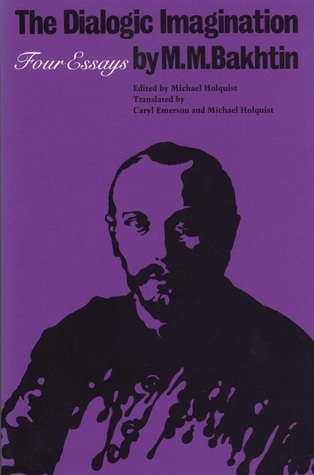
The Dialogic Imagination: Four Essays
by Mikhail Bakhtin
Sponsored
Synopsis
These essays reveal Mikhail Bakhtin (1895-1975)--known in the West largely through his studies of Rabelais and Dostoevsky--as a philosopher of language, a cultural historian, and a major theoretician of the novel. The Dialogic Imagination presents, in superb English translation, four selections ...
These essays reveal Mikhail Bakhtin (1895-1975)--known in the West largely through his studies of Rabelais and Dostoevsky--as a philosopher of language, a cultural historian, and a major theoretician of the novel. The Dialogic Imagination presents, in superb English translation, four selections from Voprosy literatury i estetiki (Problems of literature and esthetics), published in Moscow in 1975. The volume also contains a lengthy introduction to Bakhtin and his thought and a glossary of terminology.
Bakhtin uses the category "novel" in a highly idiosyncratic way, claiming for it vastly larger territory than has been traditionally accepted. For him, the novel is not so much a genre as it is a force, "novelness," which he discusses in "From the Prehistory of Novelistic Discourse." Two essays, "Epic and Novel" and "Forms of Time and of the Chronotope in the Novel," deal with literary history in Bakhtin's own unorthodox way. In the final essay, he discusses literature and language in general, which he sees as stratified, constantly changing systems of subgenres, dialects, and fragmented "languages" in battle with one another.
Bakhtin uses the category "novel" in a highly idiosyncratic way, claiming for it vastly larger territory than has been traditionally accepted. For him, the novel is not so much a genre as it is a force, "novelness," which he discusses in "From the Prehistory of Novelistic Discourse." Two essays, "Epic and Novel" and "Forms of Time and of the Chronotope in the Novel," deal with literary history in Bakhtin's own unorthodox way. In the final essay, he discusses literature and language in general, which he sees as stratified, constantly changing systems of subgenres, dialects, and fragmented "languages" in battle with one another.
You May Also Like

On Call: A Doctor's Journey in Public Service
Anthony Fauci

Duel at Araluen (Ranger's Apprentice: The Royal Ranger #3)
John Flanagan

Civil Law and Litigation for Paralegals (Aspen Paralegal Series)
Neal R. Bevans

Too Young to Parent: One baby, one scared young mum, one social worker with an impossible decision
Carey Patterson

Clans of the Alphane Moon
Philip K. Dick

Dr. Pestana's Surgery Notes: Top 180 Vignettes for the Surgical Wards (Kaplan Test Prep)
Carlos Pestana
Art Picks
View All
The Final Act of Juliette Willoughby
Ellery Lloyd

Blank Space: A Cultural History of the Twenty-First Century
W. David Marx

The Lonely City: Adventures in the Art of Being Alone
Olivia Laing

Greenglass House
Kate Milford

Love Letters to the Dead
Ava Dellaira
There Was a Party for Langston
Jason Reynolds
