12
0
📍 Noticed
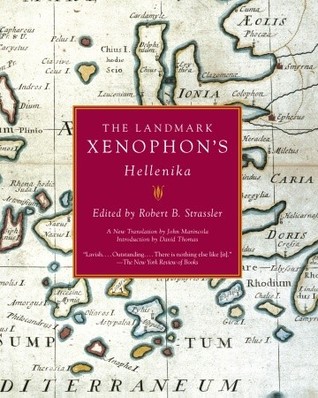
The Landmark Xenophon's Hellenika (Landmark Series)
by Xenophon
Sponsored
Synopsis
Hellenica=Ἑλληνικά means writings on Hellenic subjects. Several histories of 4th-century Greece, written in the mold of Thucydides or straying from it, have borne the conventional Latin title Hellenica. The surviving Hellenica is by the Greek writer Xenophon & one of the principal ...
Hellenica=Ἑλληνικά means writings on Hellenic subjects. Several histories of 4th-century Greece, written in the mold of Thucydides or straying from it, have borne the conventional Latin title Hellenica. The surviving Hellenica is by the Greek writer Xenophon & one of the principal sources for the final seven years of the Peloponnesian War not covered by Thucydides, & its aftermath.
Many consider this a very personal work, written by Xenophon in retirement on his Spartan estate, intended primarily for circulation among his friends, for people who knew the main protagonists & events, often because they had participated in them. His account starts in 411 BCE, the year where Thucydides breaks off. It ends in 362, the year of the Battle of Mantineia. There is virtually no transition between the two works, to the extent that the first line of Hellenica is translated as After this, or sometimes Following these events.
Many consider this a very personal work, written by Xenophon in retirement on his Spartan estate, intended primarily for circulation among his friends, for people who knew the main protagonists & events, often because they had participated in them. His account starts in 411 BCE, the year where Thucydides breaks off. It ends in 362, the year of the Battle of Mantineia. There is virtually no transition between the two works, to the extent that the first line of Hellenica is translated as After this, or sometimes Following these events.
You May Also Like
Jackpot
Nic Stone

The Diamond Eye
Kate Quinn

Three-Fifths a Man: A Graphic History of the African American Experience
Sid Jacobson
Crown of Ruin and Redemption (Kingdom of Shadows Series Book 3)
Vi Carter

Fads and Fallacies in the Name of Science
Martin Gardner

This Way Up: When Maps Go Wrong
Mark Cooper-Jones

![呪術廻戦 24 [Jujutsu Kaisen 24]](https://m.media-amazon.com/images/S/compressed.photo.goodreads.com/books/1709246290i/84024923.jpg)


